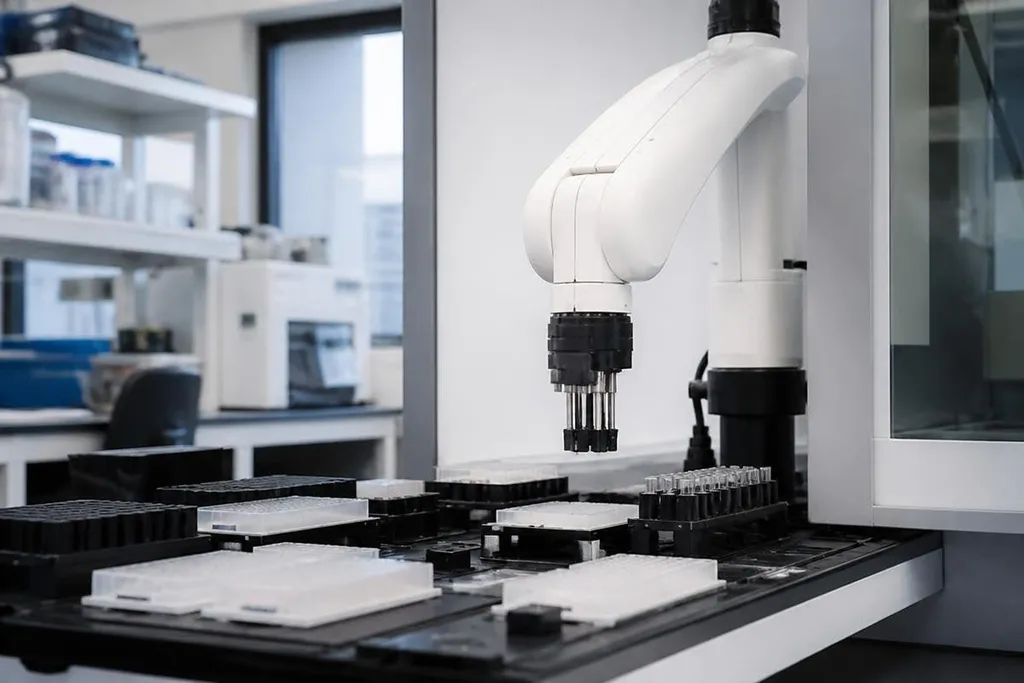
A laboratory robot can move plates, add liquids, read results, or manage samples. The harder test is whether it can complete a full task without a person fixing each step. That is the question behind better laboratory automation.
- Full tasks matter more than single-arm demos
- Sample tracking must stay correct from start to finish
- Buyers should ask what happens when a step fails
The robot has to understand the whole task
Many lab tasks contain a chain of small actions. A robot may pick up a plate, place it on a deck, add liquid, wait for a reaction, and move the plate to a reader. Each action can work on its own while the full process still breaks at the handoff.
That handoff is where lab automation earns or loses its place. The robot needs to know which sample it is holding, which step comes next, and whether the equipment is ready. A system that repeats one motion well may still need a person to manage the rest.
Future systems will need software that links instruments, sample records, and robot actions. In plain terms, the system must know what happened, when it happened, and what should happen next.
Sample handling is the real test
Laboratories do not move empty objects. They move samples that can be small, fragile, hazardous, or costly to replace. A gripper that works with one tube may struggle with another tube, a wet surface, or a rack placed slightly out of position.
That makes sensing as important as arm movement. Cameras can check position. Force sensors can detect contact. Barcode readers can confirm identity. Each tool answers a different question, and the system needs a clear response when the answers disagree.
A useful robot should also record failed actions instead of hiding them. If a pipette misses its target, the software should mark the sample and pause the task. A quiet error can damage a whole batch before anyone notices.
A lab robot’s test record should show the failed run, sample type, test date, and human response. A report from Robot 24 can place those details beside the robot’s claim, so you can tell what happened beyond the clean result. The next section puts the remaining claims to that test.
Where the claims still need proof
Manufacturers can show a robot completing a clean sequence on a prepared bench. That proves the sequence is possible. It does not prove that the robot can run through a full day of changing samples, blocked tools, empty racks, and delayed instruments.
The missing proof is often recovery. Can the robot detect a dropped tube? Can it stop before mixing the wrong samples?
Can a technician change the task without calling the maker? Can the system explain its last action after an error?
These questions matter because lab work has a high cost for mistakes. A fast arm that needs constant supervision may save little time. A slower system that keeps records and handles routine faults may fit a lab better, but that claim still needs measured results from a real installation.
Price also needs a wider view. The robot itself is only one part of the bill. Buyers may need grippers, safety equipment, software links, training, service visits, and changes to the lab bench. A low machine price can lead to a high setup cost.
A buying test for the next lab robot
Use these checks before a purchase or pilot:
- Name the full task: Write down every action from sample loading to result recording.
- Test the handoffs: Watch what happens when the robot moves a sample between tools.
- Create one fault: Remove a rack, block a station, or place a tube out of position.
- Check the record: Confirm that the system logs the sample, action, time, and error.
- Ask about service: Find out who fixes the robot and how long parts take to arrive.
- Price the whole setup: Include software, grippers, training, safety work, and support.
A lab should also decide who owns the process after installation. If only the vendor can change a task, the robot may remain tied to a narrow demo. If trained staff can edit steps, check logs, and restart safely, the system has a better chance of earning regular use.
I'd wait for proof of recovery and sample tracking before buying a robot based on a polished arm demo. The next useful benchmark is not how cleanly the robot moves one plate; it is how many complete tasks it finishes when the lab stops behaving perfectly.